





How We Solved a Low Conversion Problem and Generated 1,300+ Leads for an English Language School
Services

Challenge
This English language school had several directions: offline learning for adults, offline learning for children, and online courses for both children and adults.
The project already had advertising experience, but it was using a model that worked well in Ukraine — driving traffic to the website and collecting applications there.
On the Polish market, that model showed low efficiency, which is why the entire funnel had to be reconsidered.
Goal
Increase conversion rate.
Increase the number of applications.
Find an effective solution without fully rebuilding the site.
Results
Key challenges before launch
- the website did not convert on the local market
- low trust in an unfamiliar website
- the Ukrainian model did not work in Poland
How we solved it
- used Meta lead forms
- segmented campaigns by direction
- optimized for applications instead of traffic
- simplified the funnel
Results
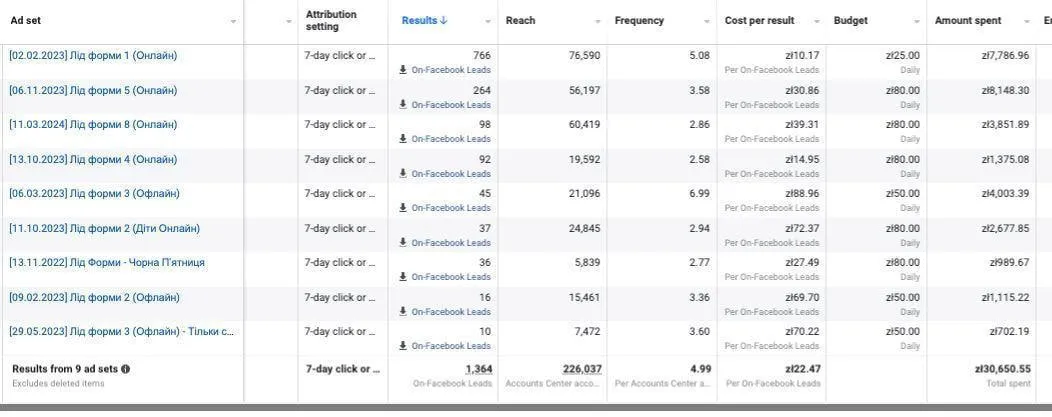
We generated more than 1,300 leads with a total budget of around 30,000 zł (~$7,500).
The average lead cost was about 22 zł (~$5.5).
Reach exceeded 226,000 users.
This is a stable and predictable result for the education niche.
Lead cost remained stable even as the campaigns scaled.
- The strategy was adapted to the local market.
- We abandoned the website as the main lead collection point.
- Lead forms removed the trust barrier.
We changed the funnel
Instead of driving users to the website, we used lead forms inside Meta. Lead forms work inside an environment that users already trust, which is why conversion to application is higher.
This shortened the user journey and removed unnecessary steps from the funnel.
Campaign segmentation
- adults offline
- children offline
- adults online
- children online
Optimization
Campaigns were optimized for applications right away, not for traffic.
Conversion
Click-to-lead conversion increased several times thanks to the simplified funnel.
At a 10–20% paid conversion rate, customer acquisition cost was approximately $30–$55.
Why it worked
In this case, the problem was not the advertising, but the conversion point.
Replacing the website with lead forms removed the trust barrier and sharply increased the number of applications.
What Worked

The strategy was adapted to the local market.
We abandoned the website as the main lead collection point.
Lead forms removed the trust barrier.
Segmentation by direction improved relevance.
A simplified funnel increased conversion rates.
Similar projects
$233k in Bookings at an Average Cost of $9: Systematic Customer Acquisition for a Restaurant in Miami


How We Built a Stable Flow of Leads for Running Training Through a Simple Offer and Proper Segmentation




How We Found Clients with $1M+ Losses Through Advertising in the Investment Arbitration Niche


.webp)
Growth of an Info Business Project in Poland to $0.28 per Follower and Stable Consultation Monetization

$3.31 per Conversation in Designer Clothing: How We Generated 271 Inquiries in a Premium Segment

How We Solved a Low Conversion Problem and Generated 1,300+ Leads for an English Language School

2,000+ Leads at ~$8: How Proper Optimization Delivered Scale for an English School

600+ Contacts for a Restaurant in Kyiv: How We Turned Ads from “Likes” into Real Reservations


Coworking in Kyiv: 586 Leads at $3.97 and B2B Growth Through Proper Qualification

How We Generated 90+ Residence Permit Leads in Europe Through Audience Segmentation and Different Offers

How We Turned Chaotic Instagram Advertising into a Stable Sales System for a Furniture Brand


How Facebook Ads Generated Over UAH 578,000 in Sales for a Gifts E-commerce Store in 1 Month

From Ad Spend to Profit: How We Generated $60,000 with Facebook Ads from a $7,133 Budget in 3 Months


How We Scaled a Military Clothing Store to 568% ROAS and $89,666 in Revenue


How We Scaled a Women’s Lingerie Brand with Its Own Production Through Google and Meta

Lead Generation Launch for a Sales Department and Recruiting Consulting Business

How We Tested and Scaled a Tech Subscription Service Through Meta + Google
How We Scaled a Crypto Exchange Through 2 Channels and Tested 2 Different Acquisition Models


How We Generated 802 Leads at $1.33 for an International Business Forum Through Advertising + SMM

How We Launched Wholesale Fuel Sales from Scratch and Got B2B Leads in the First 3 Days

How We Built a Sales System for a YouTube Income Course Through a Creator’s Personal Blog

How We Built Marketing for Premium Dental Clinics from Scratch: 2 Clinics + the Orthodontist’s Personal Practice

How We Scaled an Online English School Through Google, YouTube, Meta, and TikTok and Increased the Value of Every Lead

UAH 7.2M Through Google + 5,941 Sales from Meta for Alcohol E-commerce

How We Systematically Launched Donations for Children with Serious Illnesses Through Meta Ads

How We Rebuilt Lead Generation and Improved Lead Quality for UK University Admissions


From Zero to 197 Leads for a Construction Company Across 3 Countries


A Hiring Strategy for Mass-Market and Niche Specialists for a Recruitment Agency

From $0.67 per Registration: How We Acquired 19,824 Users for a Freelance Service

Building a Stable Lead Flow for a Business Club in Poland and Germany


Scaling a Premium Wedding Dress Brand in the USA: $6,443 Budget — 761 Leads


How We Rebuilt Analytics and Stopped Budget Waste for CarProf Autokeskus


Is your marketing not delivering results? We’ll show you how to fix it.


Let’s break down your project