






Cookieless Advertising: What Is Happening, Why It Matters, and How Businesses Can Adapt
Imagine a simple situation. You visit a laptop website, look through several models, and close the tab. Then, for two weeks in a row, you see ads for those laptops on every website and every social network.
That is not magic and not artificial intelligence. It is ordinary third-party cookies — and they are the ones that are about to disappear.
Welcome to the cookieless era.
In this article, we explain it as simply as possible: what is happening, why it is happening, what will change for businesses, and what exactly you should do right now.
Table of Contents
- What cookies are — simply explained
- Why third-party cookies are disappearing
- What is changing for business and advertising
- What is replacing cookies
- Who loses and who wins
- What to do right now
- The main conclusion
What cookies are — simply explained
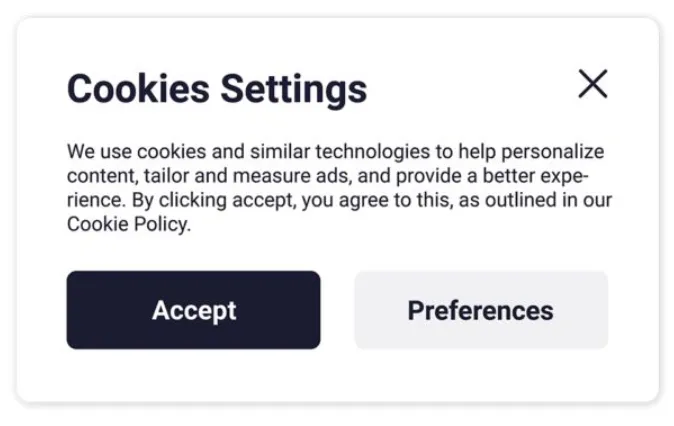
A cookie is a small text file that a website stores in a visitor's browser. It allows the site to “remember” you: your cart, language, login session.
But there are two fundamentally different types:
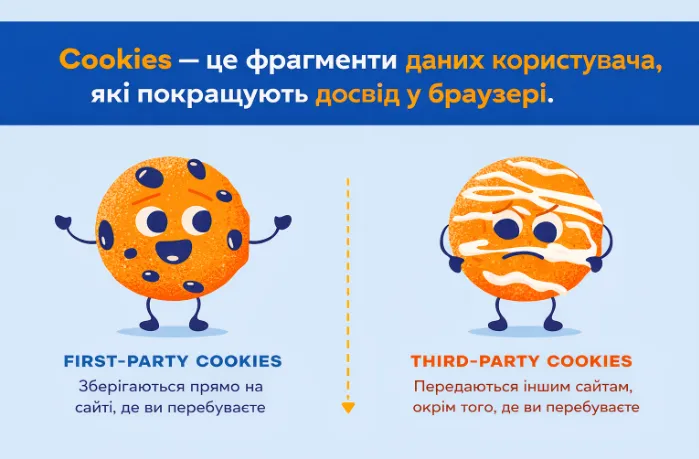
First-party cookies
These are set by the website you are visiting. They remember your settings, items in the cart, and account login. They are not going anywhere — and they should not.
Third-party cookies
These are set by third-party services: advertising platforms, analytics tools, and trackers. These cookies “travel” with you across hundreds of different websites and collect data about your online behavior.
Thanks to third-party cookies, advertisers were able to:
- launch precise remarketing to “warm” audiences
- show personalized ads based on interests
- understand what a person had viewed earlier on other websites
- collect large behavioral datasets across the internet
It worked very well — until a certain point.
▶️ See also: What Are Cookies? And How They Work | Explained for Beginners
Why third-party cookies are disappearing
Three main reasons have changed the rules of the game forever.
1. People are tired of feeling tracked
When advertising becomes too “smart”, it starts to feel disturbing. “How do they know I looked at this?” — millions of users started asking this question. Trust in digital advertising declined.
2. Legal regulation
GDPR in Europe since 2018, CCPA in California, and dozens of other privacy laws have required companies to obtain explicit consent for collecting personal data. Fines can reach millions of euros. Businesses are forced to rebuild their approach.
3. Decisions by technology giants
Safari (Apple) has blocked third-party cookies since 2017.
Firefox (Mozilla) has done so since 2019.
Google Chrome — the world's largest browser — is gradually moving away from third-party cookies and introducing its own alternatives based on the Privacy Sandbox.
This is not a seasonal trend. It is a systemic change in the infrastructure of internet advertising.
▶️ See also: Cookieless Future Advertising — What You Need to Know
What is changing for business and advertising
For most businesses, the first reaction is panic: “remarketing will die”, “advertising will become more expensive”, “precise targeting will no longer exist”.
In reality, this is not the end of advertising. It is the end of the old model.
Old logic:
“We know the person → we show them an ad.”
New logic:
“We do not know the person as precisely → we work differently.”
Remarketing becomes more difficult
You can no longer endlessly “follow” a person across the entire internet. Classic remarketing lists become smaller, and frequency becomes harder to control.
Analytics becomes incomplete
Some users simply “disappear” from tracking. Attribution becomes more complex: it is harder to understand which channel brought the client. Data no longer shows 100% of the picture.
The cost of attention rises
When targeting accuracy decreases and competition for the “visible” audience grows, CPM and CPC increase. Advertising budgets need to be spent more efficiently.
Server-side tracking becomes important
Instead of browser cookies, businesses move to server-side tracking — tracking through their own servers that does not depend on browser restrictions. It is technically more complex, but more reliable.
▶️ See also: Cookieless Future Advertising in 2024
What is replacing cookies
This is where real strategy begins. The cookieless era does not destroy advertising — it reformats it.
1. First-party data — the main business asset
The focus now shifts to data you collect directly from your own customers:
- email lists and subscribers
- phone numbers and CRM records
- purchase history and on-site behavior
- loyalty program data
- survey responses
If you do not have your own database, you are fully dependent on platform algorithms. If you do have one, you control communication regardless of changes in browsers or algorithms.
The cookieless era turns your customer database into the most valuable asset of the business.
Practical step: run an audit — how many email addresses, phone numbers, and active CRM records do you have? This is your “bank account” in the new reality.
▶️ See also: How to Master First-Party Data: Your Secret Weapon for Targeted Marketing
2. Zero-party data — data people share voluntarily
Zero-party data is information that a user gives consciously and voluntarily: quiz answers, preference choices in a profile, or test results on a website.
This is the highest-quality data you can get. A person tells you what they want — and agrees that you know it.
▶️ See also: First-Party and Zero-Party Data Tips
3. Contextual advertising returns to the stage
Previously, everyone chased the answer to “who is this person?” Now the more important question is “what are they doing right now?”
If someone is reading an article about tax optimization, it makes sense to show them an ad for an accounting service. Without knowing their name, without knowing their browser history. Just context.
Contextual advertising is not new. But in the cookieless era, it is once again becoming one of the most effective strategies, especially when combined with high-quality content.
👉 Secret Marketing sets up contextual advertising that brings clients at the moment of search — without dependence on cookies or complex targeting.
4. SEO and content marketing — your independent traffic channel
Organic search traffic does not depend on cookies, changes in advertising platform algorithms, or rising CPM. A person searches Google for “how to choose a CRM for a small business” → lands on your article → becomes a lead.
In the cookieless era, SEO and content become a strategic insurance policy:
- traffic will not disappear if Meta changes its algorithm
- every new article is a long-term asset that can work for years
- organic visitors tend to trust more than those “caught up with” by ads
- email subscribers collected through content grow your first-party database
👉 Want to get your website to the top of Google and receive organic clients without constant ad spend? Consider SEO promotion from Secret Marketing.
5. AI- and algorithm-based modeling
When a system cannot see part of the data, it starts forecasting — based on statistical patterns, aggregated signals, and machine learning.
Google is already moving in this direction with Privacy Sandbox and Topics API — technologies that make it possible to show relevant advertising without transferring a specific user's personal data to advertisers.
The result: less manual control over targeting and more reliance on algorithms. This requires marketers to think differently.
6. Server-side tracking and Conversion API
Platforms such as Meta and Google have already introduced Conversion API — a technology that allows you to send conversion data directly from your server to the advertising platform, bypassing browser limitations.
This is an important technical step for preserving data quality and campaign optimization accuracy.
👉 Need help with targeted advertising setup without dependence on cookies? Secret Marketing implements first-party data, Conversion API, and modern targeting approaches.
Who loses and who wins
Those who lose:
- businesses that live only on cold traffic and have never collected a database
- businesses without a CRM and without repeat-sales processes
- businesses whose entire marketing strategy is “launch traffic and catch up with remarketing”
- businesses that have not invested in brand and content
Those who win:
- businesses that actively collect first-party and zero-party data
- businesses with a developed CRM system that is used regularly
- brands that build a community around themselves
- companies investing in email marketing and owned communication channels
- teams that think in terms of long-term customer relationships, not one-time sales
- businesses that understand content as a strategic asset, not “blog filling”
The cookieless era is the era of systematic businesses.
▶️ See also: Embrace A First-Party Data Strategy For Sales And Marketing
What to do right now
Do not wait until the old tools finally stop working. Act step by step.
Step 1. Audit your current data Check what data you already have: emails, phone numbers, CRM records. Evaluate the quality of the database.
Step 2. Build a first-party data collection system Lead magnets, subscriptions, registrations, loyalty programs — any mechanism that gives you contact with the client's permission.
Step 3. Invest in CRM Data without a management system is just a list. CRM turns it into an asset.
Step 4. Launch or strengthen email marketing Email is one of the few channels where you communicate with your own audience, independent of social media algorithms or browser cookies.
Step 5. Implement server-side tracking Set up Conversion API for Meta and Google Ads. This will preserve data quality for algorithmic optimization.
Step 6. Develop content and brand Content attracts audiences organically. Brand builds trust. Together, they give you an audience that wants to hear from you — and shares its data voluntarily.
Step 7. Test contextual strategies Start exploring contextual targeting now — based on the topic of content, not only on the user's profile.
The main conclusion
The cookieless era is cleaning up the market.
Previously, it was possible to simply buy traffic → catch up with remarketing → push the sale. A mechanism that did not require brand, trust, or relationships.
Now it will not be that simple.
In the new reality, the winner is not the one who tracks more. The winner is the one who is trusted more.
Cookieless is not the end of digital advertising. It is the beginning of more honest, more strategic, and — for those who are ready — more profitable marketing.
Want to prepare your marketing for the cookieless reality?
Secret Marketing is a digital agency with 9 years of experience. We help businesses build marketing systems that work regardless of changes in algorithms and platforms.
or explore our services:

Is your marketing not delivering results? We’ll show you how to fix it.
We analyze your ads, website, and funnel for free — and give you a clear plan to improve performance.

We show you where your budget is being wasted
We identify real growth opportunities — not just “general issues”
We give you a clear action plan, not a 20-page report


Let’s break down your project
Thank you! Your submission has been received!
Oops! Something went wrong while submitting the form.


RELATED ARTICLES
Cookieless Advertising: What Is Changing and How Businesses Can Adapt



Автор:
Viktoriia Halata
Third-party cookies are disappearing — and the old approach to remarketing is disappearing with them. What is replacing it and how businesses can prepare.
Read Article

How Much Website Downtime Costs: Real Numbers, Loss Calculator, and How to Protect Your Business
Автор:
Viktoriia Halata
What website downtime really costs: direct losses, wasted advertising budget, SEO and reputation damage — and how to reduce these risks.
Read Article

Business Relocation Mistakes: Why There Are No Clients
Автор:
Viktoriia Halata
Many entrepreneurs move their business physically, but do not rebuild their sales model for the new market. We break down the most common mistakes after relocation.
Read Article
Post-View Attribution in Simple Terms: Why the Numbers in Ad Platforms and Google Analytics May Not Match

Автор:
Serhii Sek
The ad platform shows sales, while Google Analytics shows fewer. Who is lying, and how should you interpret this data correctly?
Read Article








Залишити заявку
Thank you! Your submission has been received!
Oops! Something went wrong while submitting the form.
